Wednesday, December 8, 2010

Final Thoughts as the Class Comes to to an End......

Before taking this class this semester, I thought that my knowledge of digital technology was pretty good.  My first wakeup call was when we had to set up a twitter account and a blog and I found myself almost a bit lost.  What I came to find as the semester went on was that having a twitter and having a blog is a great way to get information across that you think should have more coverage then it is getting.  It’s a great way to get your point across because the internet is such a great tool to spread the word to the masses.  Although I’m not sure if I’ll keep a blog once this class ends, it is definitely a tool that I have now that I didn’t have before this semester started.

Something that I didn’t really expect to learn from the course was how to take a good photograph.  It’s more than just about finding a pretty thing to photograph, it’s about the rule of thirds, lighting, and all those other concepts that we talked about.  As you can see, my skill has definitely improved from when I first took that picture with my cell phone.


From my experience this semester though, I find that there are many positive aspects of digital information.  One that I experienced firsthand was the virtual classroom that occurred right before thanksgiving.  It just goes to show how far technology has advanced to a point where people can participate in class from their homes, although a negative aspect to that are the distractions that can occur when they are at home.  The different aspects of digital information, like the internet, mixed with traditional means of gathering information have made multi-tasking almost a must-have skill for the future.  Especially with laptops in the classrooms, students well need to multi-task like never before.

Another positive aspect that I see is the way digital information speeds everything up.  Relating to my last blog posting, the high speed exchange of digital information has made it easier than ever for families and friends to keep in touch with love ones who are deployed in combat zones.  I know for me, being in touch with my family and friends on a semi-regular basis made my time over there much more bearable. 

With this exchange of digital information, there are negative aspects as well.  We learned in class how easy it is for hackers to take our information from places like our phone and computers.  After learning about how Bluetooth can be used to take information from phones, I started to make sure my Bluetooth function was off unless I was using it.  While I was in class, I put my phone in discovery mode and found other devices in the room.  I am definitely much more careful with the Bluetooth on my phone now.

For my friends that did not take this course, I would say that they should really take advantage of the things that can be done now with digital information.  Things are just done so much quicker now and you can get your voice out there if you use things like blogs and twitter.  I would warn them also though, to know how to keep safe because there are people out there who can and will steal your personal digital information if given the opportunity too.

I wasn’t quite sure what to expect from this course, but in the end, it’s is one of the few classes that I have ever taken at the University of Maryland that I was glad that I took because the information I learned is applicable to life right now.  

Sunday, December 5, 2010

My Friend, the "Expert"

When the assignment was given to find an expert relating to my blog, my first thought was that it might be a little challenging to find someone who was an expert in the field of future military technology.  My search for an interviewee ended when I decided to interview Corporal Tom Sullivan, a good friend of mine who is a combat videographer.  A lot of his job goes beyond the title of his job and actually has a lot to do with technology.


Many of the videos that we see in documentaries and the history channel were shot by people like my friend Corporal Sullivan.  Although in earlier times before the internet, these videos would’ve had to be edited then sent to somewhere to be broadcast.  In this age of technology, videos can be almost instantly viewed.  From his interview, I think the thing he was amazed with most was that with the technology that we have now, the time between taking the video and having it seen by the masses has been shortened significantly.  He mentioned websites like flickr and Facebook where photos and videos can be uploaded and seen.  He also mentioned something that I mentioned in my very first blog post, that the internet allows loved ones to communicate back and forth with each other, a huge boost in morale.  This instant way of communication really opens up a lot of possibilities.

Perhaps in the future, we could have cameras mounted on actual service members as they are in the midst of a firefight, allowing commanders away from the fight to direct their forces in the most effect manner possible.  This instant video communication could be a great asset to military commanders as a way to quickly assess the conditions of an operation or firefight.  In a previous post I described the blue force tracking system for vehicles, but something like that could be applied to actual service members on the ground.  This way they could be tracked in real time.  Although something like this sounds like something out of a science fiction movie, I believe that this is the way that we are progressing.   If they can do it for vehicles, then they could definitely do it for people.  The tracking systems, at the moment, are very expensive (almost $3000 per system) so I see that as one obstacle for implementation.  In my personal opinion though, any information gathered using these mean should only be used after the fact, as a way to review what worked and what didn’t work.  I feel that if you put a person in charge who’s away from the fight in front of a bunch of screens, it almost dehumanizes the people they are commanding because they’re not seeing people, but looking at screens.

The biggest newsmaker right now is the new “smart” rifle, the XM-25 (http://news.yahoo.com/s/afp/20101201/sc_afp/usmilitaryweaponsafghanistan).  It is a weapon, about the size of a rifle,  that is shoots microchipped ammunition that can target and kill enemies behind wall or cover.  If there are enemy forces firing from a building for example, traditional tactics would have you either drop HE (high explosive) on the building or have friendly forces clear the building.  These two tactics both have significant chances of loss of life, both friendly and civilian.  With this new smart rifle, if you know that the enemy is behind cover, you can shoot the round through a window or wall and program it to explode a foot or two after it.  The Army states that, compared to older technology, there will be “very limited collateral damage.”  So far, only the Army (which, I think we all agree, is only 2nd best to Marines) uses this weapons.  My only concern with using such a technologically advanced personal weapon is the loss of skills.  If a computer on the rifle does all the calculations for you and all you have to do is point and shoot, what happens to your marksmanship skills?

The Marine Corps had this problem when it implemented the RCO (rifle combat optic) on M16’s and M4’s.  What was found was that there was a loss of marksmanship skills and habits because shooters felt that they didn’t need it because they were using it with a scope.  With that finding, the Marine Corps put a bigger emphasis on the fundamentals of marksmanship.

The advancement of technology in recent years has greatly affected the way wars are fought.  A common misconception is that with technology things are easier and technology can replace things.  Further emphasis needs to be put on combining traditional techniques/technology with current technology.


Sunday, November 7, 2010

Why Does Half the World Have a Mobile Phone?

Much of the previous research in regards to a populations attitudes toward mobile phones (ATMP) has focused on European and American mobile phone users, usually young adults.  But, previous research regarding attitudes towards computers has found that Chinese participants show a attitudinal dimension that is different from Westerners.  Thus, this study goes to try and examine the ATMP’s of the Chinese population. 
The study hypothesizes three dimensions of ATMP, they are the sense of security, self-character extension, and dependence.  The sense of security refers to a mobile phone’s ability to make someone feel less uncertainty and safe.  The sense of self-character extension emphasizes that a phone is an extension of that person.  The sense of dependence means that a person becomes more and more dependent on their phone because of the increased involvement and easy access that mobile phones now offer. 
When all the numbers that they found were interpreted, what was discovered was that their hypothesis that the population has three dimensions of attitudes toward mobile phones is supported by the data.  Another thing that was found was that the sense of dependence that mobile phone users have is more of a psychobehavioral effect, meaning that instead of a more problematic view of mobile phone use, the user just sees it as normal use.  Furthermore, the study found that the significant correlation between mobile phone attitude and use fill the gap between theory and practice.  For example, if you use your phone to text and send e-mails you may be more dependent on your phone (sense of dependence) whereas if you’re into taking photographs or playing games on your phone, you use your phone in a more personalized way (sense of self-character). 
As with all studies, there are limitations to this study.  One is that the reliability estimates for the ATMP measure is low.  Also, this study did not consider psychological and social factors influencing the snse of self character extension and self dependence.  Lastly, the sample was of only China, so a study on a more global scale could either confirm or disprove the results of this survey.
I believe that research into this field could be potentially very profitable for cell phone companies and carries.  More research could mean a way to perhaps personalize phones or maybe make it easier for people to choose a mobile phone based on measurements in their sense of security, self-character extension, and dependence.  People could get the features on their phones that pertain to what they would only want and need without any of the excess features that, for them, are unnecessary.  For example, the research study gives the example that for the old and weak, a mobile phone is viewed as a necessity in case of emergency.  This means that the old and weak would want a phone that is geared towards fulfilling the sense of safety, so maybe a phone that is very reliable in making calls and easy to use without any unneeded features like a camera?  If things like this are put into consideration, I think people would be much more inclined to buying a mobile phone because the phone would be made for them.  Plus, people with a high sense of self-character extension would love a phone personalized to them. 


Sunday, October 31, 2010

Military Technology Through My Pictures

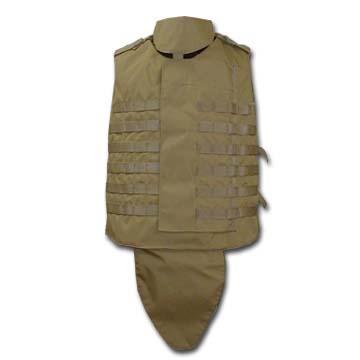
I took this picture of some of my gear using my front porch as my scenery.  I have two combat helmets up there, the one on the left is what I was initially issued when I joined the Marine Corps, and the other on the right is one I was issued 3 years later.  They may look almost identical, but they are a great example of the advancement of military technology.  The one on the right is the Lightweight Helmet, and just as it names invokes, it is much lighter and just as strong as the thicker, heavier PASGT helmet on the left.  The lightweight helmet is designed to reduce strain on the neck and is better padded on the inside.  From personal experience, it is much easier to turn my head in the lightweight helmet then in the PASGT helmet.  The PASGT helmet just feels like a heavy weight on my head.  Below the helmets, is my Interceptor Body Armor, which is the body armor being phased out right now.  I have worn the newest body armor, the Modular Tactical Vest (MTV), and it is much more comfortable and provides more protection. 
The MTV
The Interceptor Vest


This may be a little harder to interpret in regards to Military Technology, but it is very relevant.  It is a picture of my laptop with the program Skype pulled up.  It is a program where you can do free video chatting and/or phone calls (for a small montly fee).  I included this picture because this is an invaluable tool to communicate back home when you are away. Being able to talk with family and friends back home really is good for your mind and morale, which makes you a more effective at your job.

Saturday, October 23, 2010

Explanatory vs. Generic Images

GENERIC
This is a great picture showing an example of how advanced military technology is and how advantageous it could be.  This shows a US Army soldier flying a Tactical Unmanned Aerial Vehicle.  Tactical Unmanned Aerial Vehicles have been used for reconnaissance and intelligence since the 1950s, but have recently been used for combat support as well.  This picture is definitely informative, but only if you have read my blog.  Without reading it and having prior knowledge on military technology, you might not understand what's going on in the picture. 


EXPLANTORY


This is a graph that shows the relationship of US military spending in relation to the rest of the world. This being a graph, is very easy to get information from, and the take away message from this graph is that the United States spends a LOT of money on military and defense.  This graph kind of gives a sense to the readers of this blog how much it costs to have and develop such advanced military technolgy.

Thursday, October 14, 2010

Privacy Survey and Further Research

The potential survey takers for our survey were limited to those who were employed and used computers on a consistent basis for their work.  The people that we surveyed in particular though, were people who worked on computers controlled and monitored by the Department of Defense (DoD). DoD would have to follow the Electronic Communications Privacy Act of 1986, whichgave general guidelines that allowed for the monitoring of employees.  For those interested in the DoD policies, they can be found at http://www.defense.gov/webmasters. To understand the results of the survey, first here are the questions:
1. Age:
2. How would you rate your own computer literacy:  Not very illiterate, Good Enough, Very Good
3. Do you know your employer’s policies regarding the monitoring of you e-mail and internet access? Yes or No
4. Do you know the limitations of your employer in regards of what they can and cannot monitor? Yes or No
5. How important is computer access, more specifically e-mail and the internet, to your job.  Not very important, Important, Very Important
6. How often do you visit youtube or social networking sights per day?  1-3, 4-6, 7+
7. How comfortable do you feel using email and the internet on a monitored computer?  Not very comfortable, comfortable, very comfortable
8. How do you feel your productivity has changed since access to youtube and social networking sites were allowed? Up, Down, or the Same
9. Do you think you would benefit from restricted e-mail and internet access? Yes or No
80% of those surveyed rated their computer literacy as good enough, but only 60% of those surveyed knew the DoD’s policy on monitoring e-mail and internet access.  Of that 60%, only half of them knew what the DoD could and could not look at.  That means only 30% of those surveyed knew the limitations, and even though so few knew the limitations, 80% of those surveyed were either comfortable or very comfortable using email and the internet on a monitored computer.   80% said that the internet and e-mail was either important or very important to their job, so shouldn’t more know about what can and cannot be looked at by the DoD?  It is surprising that such a high percentage doesn’t know what the DoD cannot look at when a high percentage finds the computer so important to their work. 
Another very important question about the use of government computers was the effect monitoring had on their job performance.  Since this past April, unclassified government computers are now allowed access to social networking sites and youtube as long as it is done carefully.  What we wanted to see was the correlation between this, monitoring, and productivity.   What we found was that of the 80% that were comfortable using email and internet on a monitored computer (showing unaffected performance, despite monitoring), 75% said that their productivity was either the up or the same since access was granted to social networking sites and youtube.
In conclusion, it seems that, according to this survey, most know about the policies regarding the monitoring of email and internet, but not the limitations.  It also seems as though work performance is generally not negatively affected by the monitoring of employees or social networking sites.  Social networking sites do not seem to negatively affect performance and productivity because most of those surveyed did not report their productivity decreasing.  In our opinion, in might even increase activity because it allows employees to take a sort of a mental break from working and come back re-energized.  
Research done in the electronic monitoring of employees has come to a much different conclusion then the one made by us and our survey.  The majority of studies have found that electronic monitoring frequently increases employee stress levels leading to employee job dissatisfaction. Specifically , research done by Rebecca Grant and Christopher Higgins entitled, “Monitoring service workers via computer: The effect on employees, productivity, and service” found that monitoring becomes less acceptable to employees as monitoring becomes more and more pervasive.  Employees begin to feel as if the electronic monitoring is acting as their supervisor, even though they feel it cannot handle things as well as a human supervisor could.  As a result of this, a feeling of a loss of control by the employee is felt, and those who feel like they have lost control tend not to feel very satisfied with their jobs.  Those not satisfied with their jobs, not surprisingly, do not work as well and have low job productivity.   
Also found in that same research article was the results of a survey of 1,500 employees in 50 Canadian service firms.  What they found was that as the number of tasks monitored by the employer increased, the employees increasingly believed that production was more important to their employer than quality.  Their conclusion was that employees may reduce quality unintentionally in their attempt to live up employer expectations. 
This research article was published in 1989, much before the popularity of the internet and social networking sites. Even in 1989, the electronic monitoring of employees and its affect on them was an issue. The boom in monitoring technology only foreshadows how much of an issue that this will be now and in times to come. The landmark Supreme Court case Ontario v. Quon gave the upper hand to the employers, but this case will only fuels the argument for employment monitoring and everything affected by it, including productivity.
In the case of Ontario v. Quon, the city of Ontario had provided SWAT team members with alphanumeric pagers after Sgt. Quon had exceeded his allotted usage limit. The city acquired transcripts that provided them with information that Quon had been using his pager for personal usage, and some of the messages he had sent out were sexually explicit. Those who were found sued citing a violation of the fourth amendment, which guards against unreasonable search and seizures. The Supreme Court found that this search was in fact legal because the search was motivated by legitimate work purposes.
In an HR issues and answers Q&A, from an employer’s perspective, email monitoring is legal as long as you look at only email in storage, not outgoing email. Also, an employer may review its employees’ telephone conversations for business purposes, but may not record private conversations. The federal Electronic Communications and Privacy Act of 1986 does not allow employers to record all personal conversations for later monitoring. Conversations between employees via headsets are also monitored.
A 2008 Q&A with Microsoft also notes a type of monitoring called “activity-centric monitoring” employees are monitored, for example for the number of key strokes they make, which is analyzed against performance

Sunday, October 3, 2010

Sshhh...It'sa Secret

Secrecy has always been such an important factor of military technology.  One only needs to think of the secrecy that surrounded the Manhattan Project, the code name for the United States’ program to develop the atomic bomb.  This project was very secretive because they did not want anybody, especially the Germans, to get a hold of any of their information.  If they did, they could have possibly used it against us.  I think a good sports analogy for this is if you are a football coach and have a certain strategy for a game.  if the opposing team finds out your strategy, then can either devise a plan against it or even use your strategy against you. 
The F-35 Lightning II is a 5th generation, single seat, single- engine stealth multi-role fighter jet, developed by Lockheed Martin, slated to enter military service in 2014 with the USMC first.  It has been under development since 1993 and many of the details of it have been kept very secret because of the advanced capabilites that this plane will have.  With a flyaway cost of $192 million for ONE unit, this is the kind of technology and investment that the United States wants to keep under wraps.  Unfortunately though, there were media reports back in April 2009, citing Pentagon sources, that said that computer spies had managed to copy and download several TERABYES of data related to the design of the F-35 and the electronic systems of the aircraft.  This information is potentially very dangerous because with this kind of information, defense systems could be developed against the aircraft.  It is noted that Lockheed Martin denies any of this happened, but one of the media outlets that reported this was the Washington Post, a pretty credible news outlet. 

Google Maps Covers the World

In class, while we were using the Bing search engine’s maps to do an aerial view and bird’s eye view, it made me curious to see how comprehensive these maps were of the Earth.  What I decided to do was tosearch for on Google Maps, Al Asad Airbase, Al Anbar, Iraq.  I had been deployed there for five months, so I know the base pretty well.  What I found on Google Maps really surprised me.  I expected that the largest military airbase in western Iraq would be covered or something, but it wasn’t.  Not only could you find the location of the base, you could see, in very good detail, building, roads, and even parked helicopters!  They briefed us before we got there that you could see the base using Google Maps, but that was before I had even been there, so a map of a place I didn’t know didn’t mean too much to me.  Now though, it’s kind of scary.  Using google maps, I could see exactly where I had slept, the building I worked in, the chow halls I ate in, and I could even see the exact roads where I used to run.  One can only imagine how an attack to that base would be more effective with knowledge of the base and google maps.  Google Maps says it uses outdated imagery for any areas deemed potential security threats, but let me tell you, what’s on google maps is VERY accurate.

Saturday, September 25, 2010

What's good?


When it comes to what the latest and greatest technology that our military has to offer, I would have to say the official military websites for the individual branches of armed services have the best, most reliable information.  The military is part of the government, so all of the information that is accessible to the public on those websites is a direct representation of the government.  All of that information is edited and proofread to make sure all the information is correct.  I believe though, there may be a slight exaggeration sometimes, but I feel like that is only really done to make a boring articles about the military a little bit more interesting.  Nobody likes to read an article about the specifications of a certain new piece of equipment, but a little information regarding what the new piece of equipment might do might draw readers to read the full article and come back to the site later for more information.  Being a Marine, I’ve only really gone to marines.mil, where they have a “News” section that will periodically have articles on new equipment and technologies. 
I also think that any news articles that are a part of the AP (Associated Press) are very good and reliable news sources.  The AP is a very credible because it has a strict set of standards and guidelines to its news articles.  They don’t even produce any kind of information from anonymous sources unless:
1. The material is information and not opinion or speculation, and is vital to the news report.
2. The information is not available except under the conditions of anonymity imposed by the source.
3. The source is reliable, and in a position to have accurate information
For more information, the AP issued a statement in 2006 regarding their values and principles; the link to it is http://www.ap.org/newsvalues/index.html
Any information you find on personal blogs or any kind of blog or article where there are no specific standards or guidelines to their writing, that’s when you should be a little wary of what they say.   There are really no checks and balances to what a blogger might write.  A blogger is free to write what they wants, so they can put their own opinion on things, and even skew the facts so that something that they might like is seen in a negative light.  In those situations, it is best to take that information at face value only and research it some more using official military sites or AP news outlets/articles.  An example of a good blog site, however, that I found was http://bit.ly/azDD7V.  (If you clicked on the link, you find that it’s my own blog, but I do my research, and any information you find here is totally true either from research or personal experience.)
So I searched “military technology,” and the first page was full of websites devoted to military technology, but they were all by private companies, companies that have no obligation to the government to give credible information.  I was a little surprised that there was no government sponsored site, but I guess that’s the illusion of control caused by searching and googling.  Like my previous blog post, I encourage you to look for, in your own life, how the illusion of control affects your actions. 

Sunday, September 19, 2010

illusion of control

Many, if not all, people have their own superstitious beliefs that compels them to do rituals before an event, small or large.  I knew some Marines who would always pray before going outside the wire, but in actuality, if they prayed or not, that IED (improvised explosive device) would be in that road no matter what they did before going out.  What matter to them though, was that they felt safer going out because they had been able to pray.  This is the illusion of control.
Just like you see basketball players bounce it twice before shooting a free throw, they feel like the bounce will help them to make the free throw.  The illusion of control is the tendency for people to believe that a desired event occurs when they do a certain behavior.  It was first developed by Dr. Ellen Langer, the first female to ever be tenured in psychology at Harvard University.  The illusion of control is one of the three “positive illusions,” the others being illusory superiority and optimism bias.
Dr. Ellen Langer’s research found that people were more likely to behave in such a way that they thought they had control over an event if it involved, “skill cues.”  Skill cues are related to situations in which the person believes skill has something to do with the outcome.  The best example of this was found in gambling (rolling dice in craps); research showed that people would throw dice hard trying to get a higher number but throwing softer for a lower number.
Since coming out with this theory in 1975, there have many complementary theories and many criticisms as well, but it is hard to argue that the illusion of control does not exist when we do it every day of our lives.

Sunday, September 12, 2010

Weapon of Mass Destruction for the Masses

The internet is such a valuable tool that has grown exponentially in terms of usability and technologically in the past 5 years and it doesn’t look like it’s going to slow down anytime soon. Not surprisingly, the Defense Department was the one who developed the computer system in which the internet evolved from. The ability to keep academic and military researchers in contact really helps to speed up the time it takes to develop something. Without it, imagine having to write a story with somebody by mail correspondence only…that would take much longer then if you had your friend right next to you.


That development led to the internet, which, according to the article, only had 25 million daily computer users in 2005. That number really shows how much the internet has grown, as facebook, arguably the most popular of the social networking sites, just recently passed its 500 million user mark. Also showing the internet’s growth is its development of software to combat some of the perils of the internet. The article begins with an example of how spam e-mails negatively affect the internet, but my initial reaction was, “what about spam and pop-up blockers? From what I remember, spam blockers and pop-up blockers were really just initially being implemented.

Although spam and pop-up blockers are now used in full force, the internet’s growth has not been all positive. The internet is an open forum for anybody to write and produce whatever they want. Recently, many classified documents from the war in Afghanistan were illegally posted on a website called “wiki-leaks.” You can imagine the operational security risks that documents like that can present and the potential danger it can have on our military overseas. .

Wednesday, September 8, 2010

No "Busy" Signal with the Internet

Earlier, I briefly introduced you to the topic of military technology and the human effect of it. Well you see, the military is always trying to improve itself to be a more efficient fighting machine and minimize damage and better equip its most valuable resource, the individual service member. This is done by advancing current technologies and creating new ones. Keeping in pace with the communication technology boom of the last 10 years, arguably the most critical improvements made by the military have been in how the military communicates.

When the military finds a need for something, most of the time, they will usually let all the major defense contractors know that they have a need for a device to do a certain thing. Then these contractors all make a product fitting that description and try to win a government contract. The military was the first to come up with the idea of GPS in 1973 and launched a satellite called NAVSTAR 1 (an acronym for Navigation Satellite Timing and Ranging) in 1978. In 1993, the final satellite needed to use GPS was launched. More satellites have been sent up since to enhance and refine the system, which gave birth to the Blue Force Tracking system (run by Harris Corp, under contract to Northrop Grumman) . The Blue Force Tracking system allows for more accurate tracking which before was done with a map and compass and depended on the navigational skill of the person relaying the position back. All the information is sent over radio communications and satellites.

By far the biggest thing that has influenced military technology is the internet. Before the internet, there was no other communication medium that was so convenient and able to reach so many people at one time. Instead of 100 calls to 100 different people, there could be just one e-mail for those 100 people. The internet over in Iraq and Afghanistan is not done by hard lines like here in the US, but by satellite. So if a satellite was down, an e-mail is much more easily re-sent than constantly re-dialed like a phone call. Ten years ago, it would have been near impossible to get a mass message to troops, but now with the internet, it’s possible. One of the biggest problems a military may have is getting certain information across, but with the internet, it was much easier.

The prevalence of the internet has also greatly affected the individual service member in that, it now allows for easier communication back home. Twenty years ago, if you were in a combat environment, it would have been very hard to get just a phone call out to your loved ones. Now you have computer rooms where a service member can video message his loved ones and exchange e-mails with friends and family. This moral boost has immeasurable benefits for a service member.

The greatest problem with technology though, is the abuse of it. The most recent example of this is the leaking of government documents through wiki leaks. Also, there are concerns that e-mail and video-messaging could be hacked and valuable information can be gained from it. Although it is instructed that only non-classified information go in e-mails, those instructions are not always followed. Only the future will show how the military handles these problems.

Sunday, September 5, 2010

My Topic

My blog, “The Future of War is Now,” focuses on the advances in technology and how that affects how war is fought. I also wanted to focus on the affect that technology has on the human aspect of war. Much of what you see in movies and television are not just science fiction, but things that actually do exist. I did not even realize how much technology goes into fighting a war.

I’ve been a US Marine since 2007 and I’m a small arms repairman (which just means I work with the weapons), so the only technology I ever saw or need in my training before going to Iraq was a hammer, a screwdriver, and a punch. The only time I would use a computer was if I wanted to do paperwork with it rather than writing it by hand. All of my references are very large and thick manuals, but many references, yet not all, are making their way into electronic format.

Technology, though, has a very large role in the way we fight war and its affect on US service members and that is why I have selected that topic. I was just so very astonished at how much we can do with the new technologies that we have. For example, we have something called the Blue Force Tracker system, where Marines on a convoy hundreds of miles of way can be tracked from a central location with enough accuracy that they can be told of upcoming hazards or rough terrain. Likewise, those Marines in that convoy can know where the other vehicles are, something very critical in a combat environment. And if you have every played the video game “Call of Duty,” you have most certainly heard of predator drones, drones that I heard almost every night flying around.

I also selected this topic because how the advancement of communication technology made it easier for me to contact with home, thus I want to see how it affects people. When I was over there, not only did we have phones, but we had internet, albeit, very slow internet, running through a system of satellites all over base, which allowed us to contact home and allowed us to keep up with current events. This is a very big morale boost in a highly stressful environment.

Because of my personal experiences while in Iraq, my goals for selecting this topic is that I want to further explore the technology that shapes and will further shape warfare, but I also want to further explore how technology positively/negatively affects the human aspect of war.